By: Sandhya HegdeLast updated on: February 20, 2026
Save
Share
Email
How to Conduct an ESG Audit of Your Workplace
It usually starts with a simple question. A leadership team reviews its ESG commitments and realises that while targets are clear on paper, the lived reality feels harder to define. Carbon goals are tracked at an enterprise level. Wellbeing initiatives are rolled out across teams. Governance frameworks are in place. Yet when attention turns to the workplace, the answers become less certain.
Is the office truly performing the way it was intended to? Is it supporting people in the way the organisation claims it does? And most importantly, can these outcomes be evidenced with confidence?
This is often the moment when organisations realise that alignment is no longer enough. What they need is visibility. This is where an ESG audit of the workplace begins.
When ESG Moves From Principle to Place
Workplaces are among the most tangible expressions of ESG strategy. They consume energy daily, influence behaviour continuously, and shape employee experience at scale. Yet they are also where ESG gaps surface most clearly. Over time, workplaces tend to evolve in fragments. An expansion here, a retrofit there, a new landlord, a new vendor, a new design brief. Each decision makes sense in isolation. Collectively, they create complexity.
An ESG audit brings coherence to this complexity. It allows leaders to step back and see the workplace not as a collection of projects, but as a living system that carries environmental, social, and governance implications every day.
ESG Audit as a Strategic Journey: Step-By-Step Guide
Step One: Pausing to Define the Question
Before any data is gathered, the most important step is alignment. Organisations that gain the most from an ESG audit begin by asking not what should be measured, but what needs to be understood. Some are preparing for regulatory scrutiny. Others are planning a major workplace transformation. Many are responding to internal questions from employees, boards, or investors.
This clarity shapes the audit. It ensures the process remains focused on decisions and outcomes, rather than becoming an exercise in documentation.
Step Two: Seeing Environmental Performance as It Truly Operates
The audit often reveals the first disconnect between intent and reality. On paper, buildings may appear efficient. In practice, energy consumption varies widely across locations. Systems designed to optimise performance operate manually. Materials selected for sustainability were never tracked beyond installation. Water efficiency depends heavily on context and behaviour.
An ESG audit looks beyond design specifications to understand how the workplace actually performs. It captures operational energy, embodied carbon, water use, and indoor environmental quality as an interconnected system.
What emerges is not a verdict, but a baseline. A clear understanding of where performance is strong, where it is inconsistent, and where the greatest opportunities lie.
Step Three: Listening to the Social Story the Workplace Is Telling
The social dimension of ESG is often where the audit becomes most revealing. Employee experience data, space utilisation patterns, and qualitative feedback begin to form a narrative. Some spaces energise collaboration and focus. Others quietly contribute to fatigue. Daylight, acoustics, ergonomics, and access to choice shape how people feel long before policies do.
An ESG audit brings these insights together. It reframes wellbeing not as a programme, but as an outcome of design, planning, and everyday experience.
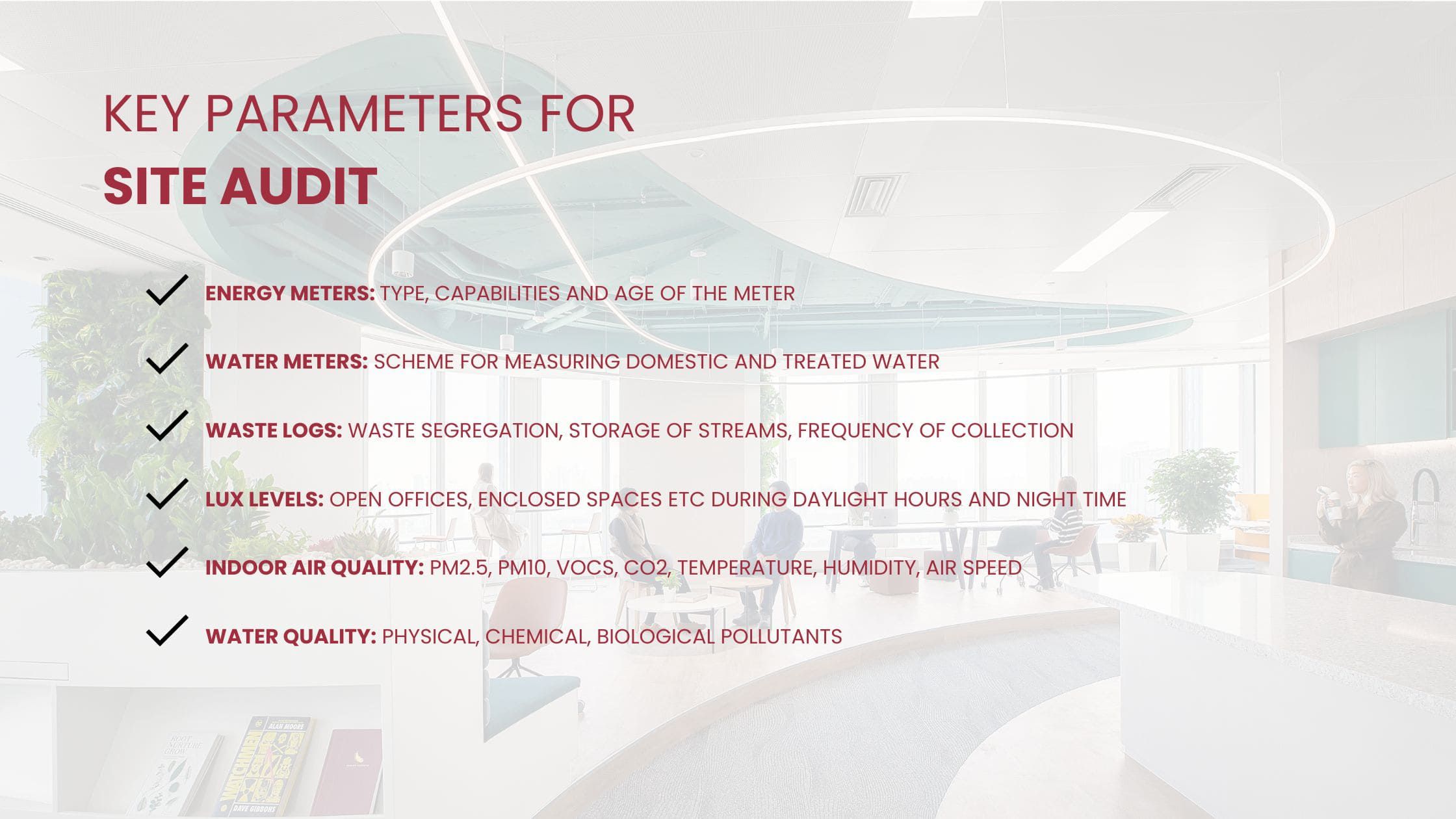
To translate this into measurable evidence, a structured workplace wellbeing audit becomes essential. Our comprehensive Workplace Audit for employee wellbeing and experience is executed through a systematic and disciplined process:
Initial Planning and Collaboration: We work closely with key stakeholders to define audit activities, align objectives, and select appropriate dates to avoid operational conflicts.
Site Preparation: A detailed checklist outlining all test parameters and instructions is shared with the facilities team to ensure site readiness.
Professional Execution: Credible, certified service providers conduct sampling and testing using approved, laboratory-grade equipment.
Audit Implementation: Data is collected through a systematic sequence of test types and appropriate methodologies. For example, noise levels are measured while the HVAC system is operational, and lux levels are recorded in the evening at both the horizontal workplane and eye level to reflect actual user conditions.
Benchmarking and Analysis: Results are reviewed against established industry standards and benchmarked using globally recognised frameworks such as the WELL Building Standard.
Is your workplace truly ESG-aligned or just operationally functional?
This structured approach moves the conversation from perception to proof. Several of our Delhi-NCR projects have achieved excellent Indoor Air Quality (IAQ) outcomes. By embedding IAQ strategies directly into the design process rather than treating them as post-occupancy corrections, we have successfully maintained PM2.5 levels below 10 micrograms per cubic metre, even during peak winter pollution conditions.
For many leaders, this is the point where the workplace stops being seen as an asset to manage and begins to be recognised as a lever for sustained organisational performance.
Step Four: Understanding the Governance Beneath the Surface
Governance rarely announces itself in a physical space, yet it determines whether ESG outcomes endure. During the audit, questions begin to surface. Who owns sustainability outcomes in the workplace? How are ESG goals translated into design briefs and procurement decisions? What data is tracked consistently, and what is assumed? An ESG audit makes governance visible. It reveals where responsibility is clear, where it is fragmented, and where intent is diluted as decisions move from strategy to execution.
This clarity is essential for scale. Without it, even well-designed workplaces struggle to deliver consistent ESG outcomes over time.
From Insight to Execution
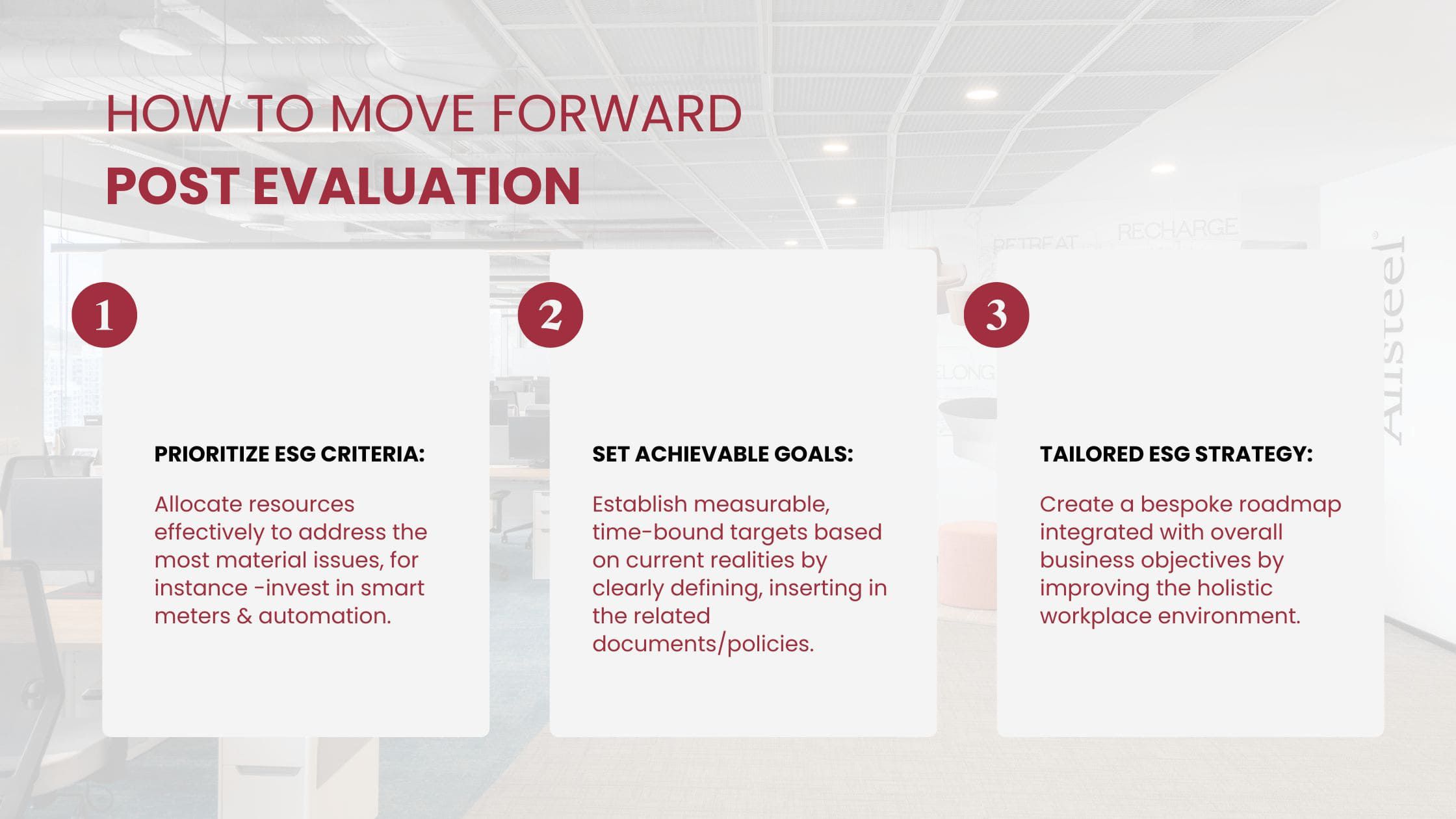
An ESG audit creates understanding. Impact depends on what follows. Translating insight into action requires integration across sustainability, design, cost, and delivery.
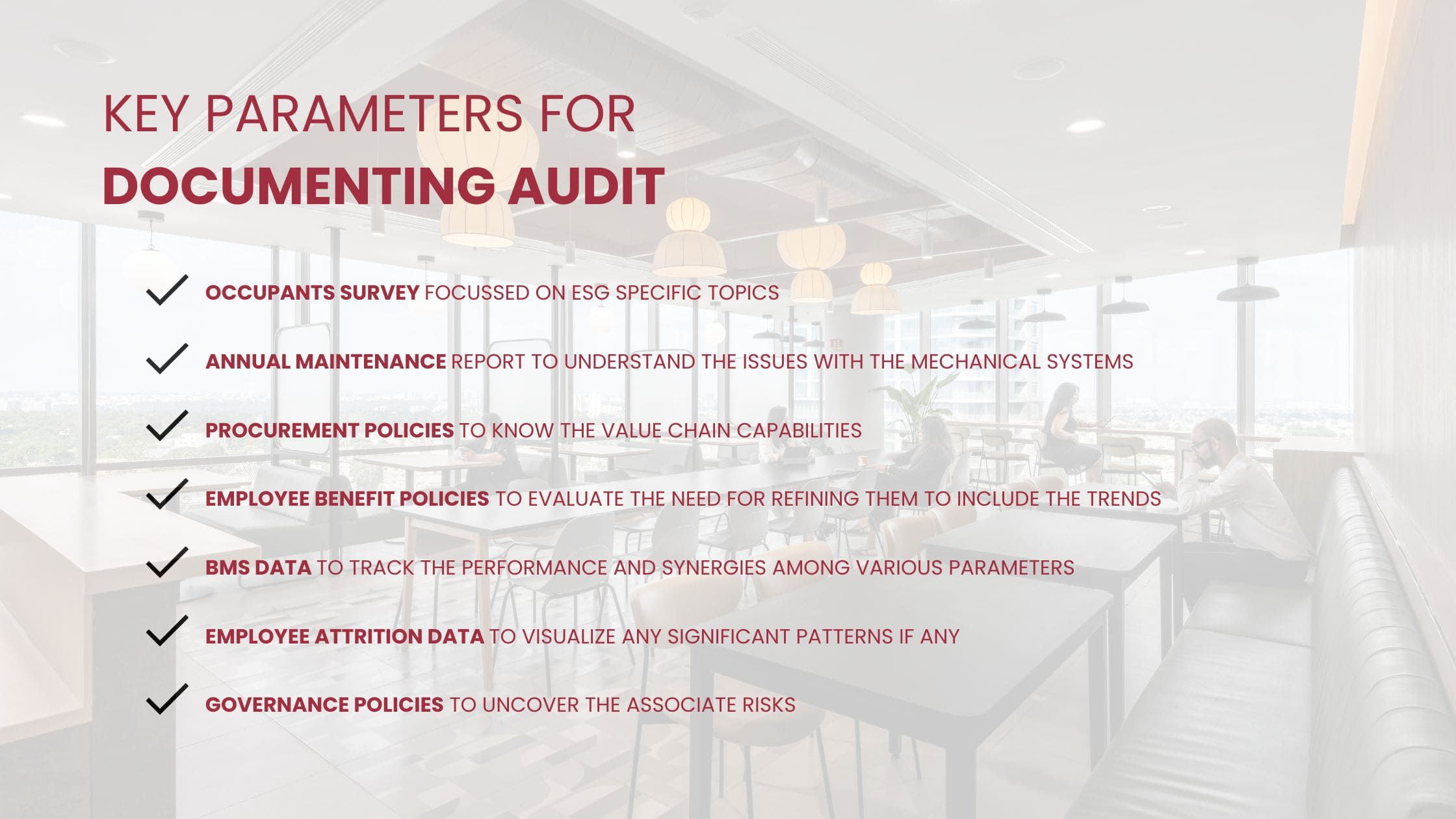
The first step after completing site and data audits is the identification of gaps and opportunities. This is where findings begin to move from observation to strategy. Environmental data and human experience insights must be synergised. For instance, correlating air quality, water quality, and sound levels with occupant survey data can reveal far more precise insights into workplace performance than reviewing each dataset in isolation. Patterns emerge. Cause and effect become visible.
In some cases, audits uncover missing parameters altogether. Critical ESG metrics may be absent due to gaps in infrastructure, processes, or internal ownership. These cannot remain blind spots. They must be integrated into existing systems to create a complete performance framework. Workplace design specialists play a pivotal role here. They are equipped to interpret audit findings holistically and propose targeted interventions that elevate performance without compromising business priorities.
Advanced technology is now reshaping how this transition happens. Platforms are automating the measurement of ESG KPIs across workplace operations and user behaviour. Space utilisation, occupancy levels, resource consumption, and even design efficiency can now be tracked in real time. This shift from static reporting to continuous data intelligence enables organisations to make informed, evidence-based decisions.
The result is not just improved reporting accuracy. It is sharper strategy. Targeted interventions. And ultimately, workplaces that are measurably more sustainable, equitable, and well-governed.
When audit insights are carried through design and execution with accountability, ESG intent is preserved. When they are not, even the most rigorous audits remain theoretical.
The Quiet Advantage of Getting It Right
As expectations around ESG continue to rise, workplaces will increasingly be judged not by intent, but by evidence. Evidence of environmental responsibility. Evidence of care for people. Evidence of governance that holds over time. An ESG audit of the workplace is not about chasing perfection. It is about gaining clarity, making informed choices, and building environments that are resilient by design.
For organisations willing to listen to what their workplaces are already telling them, the path from ESG ambition to real impact becomes far clearer. A workplace ESG audit is not about looking good-it’s about avoiding blind spots that turn into financial, people, and reputation risks.
We use cookies to enhance your experience on our website, provide personalized content, and analyze site traffic.
By clicking "Accept All", you consent to our use of cookies. You can also choose "Preferred Cookies"
to select specific types of cookies that align with your preferences.
Essential cookies are always enabled to ensure website functionality.
You can choose to have only Essential cookies if you prefer minimal tracking.
Your choice regarding cookies on this site
Please choose whether this site may use Functional and/or Personalization cookies, as described below.
By selecting Required cookies only, you are requesting us not to sell or share your personal information.