How Forward-Thinking Leaders Treat Office Design as Strategy, Not Logistics
There is a subtle but telling difference between organizations that simply occupy offices and those that use them to move the business forward.
You hear it in the language leaders use.
Some talk about fit-outs, square footage, timelines, and vendors. Others talk about experience, energy, focus, collaboration, and trust.
Both are talking about offices. Only one group is treating office design as a strategic decision.
The difference is not aesthetics. It is people.
When Strategy Ignores the Human Layer
In leadership discussions, strategy is often framed around markets, operating models, and growth targets.
But the success of every strategy depends on people. How they feel when they walk into work. How easily they can concentrate, collaborate, and recover. How connected they feel to the organization and to each other.
When office design is treated as a logistical task, the human experience becomes secondary.
The result shows up quietly.
People struggle to focus in spaces designed only for density. Collaboration feels forced rather than natural. Hybrid teams feel disconnected. Energy dips by mid-afternoon. The office becomes a place people tolerate, not one that supports their best work.
Forward-thinking leaders recognize that these are not soft issues. They are performance issues.
The Office Shapes How People Work and How They Feel
The workplace is one of the most powerful tools leaders have to influence behavior and experience at scale.
Every design decision affects how people move through their day.
Where they can concentrate
Where they can connect
Where they can pause and reset
How visible or supported they feel
Whether they experience autonomy or control
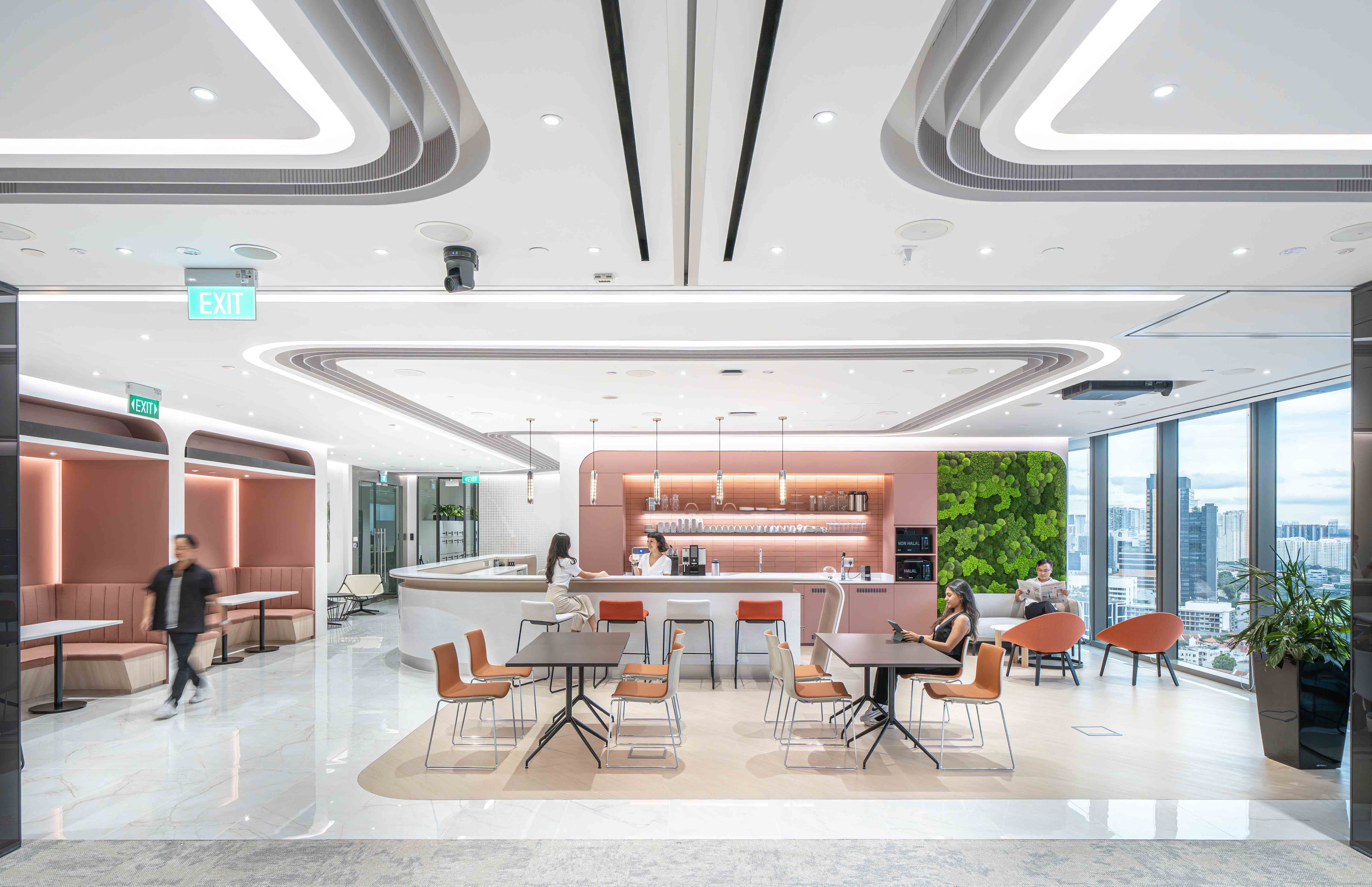
Human-centric design starts with the understanding that people do not work in one mode all day.
They shift between deep focus, collaboration, learning, informal connection, and recovery. Spaces that acknowledge this reality reduce friction and cognitive load. People spend less energy coping with their environment and more energy doing meaningful work.
This is why forward-thinking leaders see office design as an extension of their people strategy.
From Space Planning to Experience Design
Traditional office planning focuses on efficiency. Human-centric workplace design focuses on experience.
The shift is subtle but powerful.
Instead of asking how many desks fit, leaders ask how many work modes are supported.
Instead of designing for attendance, they design for intent. Why people come in. What they need when they do.
Instead of optimizing only for utilization, they balance it with wellbeing, focus, and choice.
This does not mean creating indulgent or impractical spaces. It means designing environments that respect how humans actually work.
Organizations that adopt this approach consistently see higher engagement, better collaboration, and stronger connection to culture.
People Experience Is a Strategic Differentiator
In competitive talent markets, the workplace is no longer a background factor.
It influences attraction, retention, and everyday performance.
Employees increasingly evaluate offices not by how impressive they look, but by how they make them feel.
Can I do my best work here
Do I have choice and agency
Does this space support my wellbeing
Does it reflect what the organization says it values
Forward-thinking leaders understand that when the physical environment aligns with these expectations, people show up differently.
They are more present. More collaborative. More invested.
That is not coincidence. It is design.
Designing for Trust, Not Control
One of the most important shifts human-centric leaders are making is moving away from control-based design.
Rows of identical desks, rigid layouts, and one-size-fits-all environments send a clear message. Be visible. Be compliant. Be the same.
Human-centric workplaces communicate something different.
We trust you to choose how you work
We respect different needs and rhythms
We have designed this space to support you
This sense of trust has measurable impact. Teams become more accountable. Collaboration becomes more intentional. The office becomes a resource rather than an obligation.
Leaders who understand this treat office design as a cultural signal, not just a physical one.
Why Human-Centric Design Improves Business Outcomes
The business case for people-first workplaces is no longer speculative.
Organizations that invest in human-centric design report:
Improved productivity due to reduced distractions and better focus
Lower attrition driven by stronger sense of belonging
Better collaboration supported by intentional spatial choices
Higher utilization because people want to be in the office
Smoother adoption of hybrid work models
These outcomes directly support strategic goals. Growth. Innovation. Stability. Resilience.
When people are supported by their environment, strategy has a far greater chance of succeeding.
What Forward-Thinking Leaders Do Differently
Leaders who treat office design as strategy integrate people experience from the very beginning.
They ask different questions early.
What do our people need to do their best work
What moments in the day matter most
Where do we see friction or fatigue
How can the workplace support wellbeing without reducing performance
How should this space evolve as our culture evolves
These questions shape decisions about layout, materials, technology, acoustics, lighting, and adjacencies.
Human-centric design is not layered on later. It is built into the foundation.
From Logistics to Leadership
When office design is treated purely as logistics, it is delegated and disconnected.
When it is treated as strategy, it becomes a leadership responsibility.
Forward-thinking leaders understand that the workplace is one of the few places where strategy, culture, and people experience intersect physically every day.
Getting that intersection right is not about trends or aesthetics.
It is about creating an environment where people can focus, connect, and perform without unnecessary friction.
Designing for the Humans Who Power the Strategy
Ultimately, strategies do not execute themselves. People do.
The role of the workplace is to support those people quietly and consistently.
To remove barriers rather than introduce them. To create clarity rather than noise. To offer energy rather than drain it.
This is why forward-thinking leaders treat office design as strategy.
Not because offices are important on their own.
But because people are.
And the environments they work in shape everything that follows.