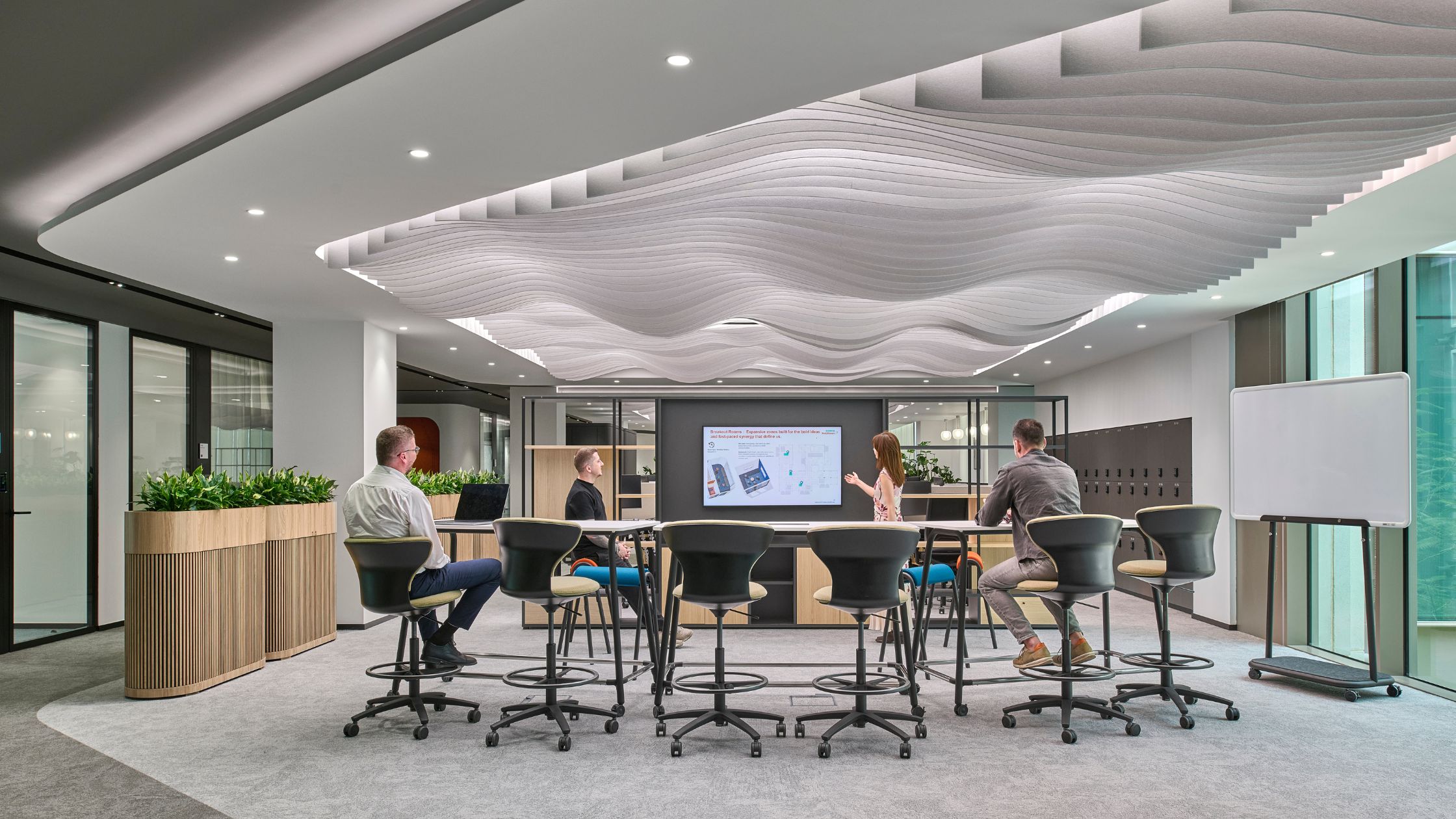
Custom-Built Offices vs Coworking: What US GCCs Choose in India
Custom-built offices in India are rapidly replacing shared workspaces for maturing multinational corporations. As the Indian Global Capability Centre (GCC) sector evolves from basic cost-arbitrage operations into complex hubs for product engineering and research, real estate requirements are fundamentally changing.
US multinationals are outgrowing early-stage coworking spaces as they expand. Scaling beyond the 500-seat mark, these enterprises are shifting towards bespoke, design-and-build environments.
This strategic transition secures long-term cost predictability, embeds stringent intellectual property security, and cultivates a distinct employer brand. The choice between coworking and custom-built office space is not merely about aesthetics, but a business decision tied directly to corporate maturity and long-term intent.
Quick Summary
India's GCC sector has matured past the initial cost-arbitrage, pilot-stage model.
Coworking suits early market entry but limits branding, security, and certification control.
Custom-built offices deliver long-term cost predictability and deep culture alignment.
The financial break-even point for custom spaces usually occurs between years two and four.
What Is Driving the Shift to Custom-Built Offices?
Coworking suits entry-stage GCCs, while custom-built environments suit scaled, strategic operations that require deep integration and security.
The Indian market now hosts over 1,700 GCCs, with the vast majority being US-headquartered multinationals. These organisations are experiencing a flight to quality as their operational mandates grow more complex. They need physical spaces that reflect their global stature, protect their core assets, and attract top-tier talent. Relying on shared spaces limits a company's ability to express its unique corporate identity.
A typical enterprise will outgrow its shared workspace when headcount crosses the critical 500-seat threshold, prompting a necessary real estate strategy review.
How GCC Maturity Shapes Real Estate Needs
GCCs typically start as support functions housed in coworking or managed space. This allows for rapid deployment while the business mandate is still being validated in a new region. Flexibility matters significantly at this early stage of the GCC maturity curve. However, as mandates shift to product engineering and advanced research and development (R&D), real estate needs change dramatically.
A mature enterprise requires dedicated infrastructure to support specialised technology and secure data networks. These advanced operations demand bespoke environments that generic office spaces simply cannot provide. The physical workspace must evolve in tandem with the business objectives to support sustainable growth.
Custom-Built vs Coworking: What Are the Key Differences?
The main differences lie in capital commitment, deployment speed, brand control, and security infrastructure.
Understanding the trade-offs between these two real estate models is crucial for Corporate Real Estate (CRE) leaders. Each option serves a distinct phase of the corporate lifecycle and operational strategy. The choice dictates how a company manages its financial resources and employee experience over a five to ten-year horizon. A thorough comparison reveals clear advantages depending on the specific growth stage of the business.
Feature
Coworking / Managed Space
Custom-Built Office
Best For
Cost Structure
Low upfront cost, higher recurring fees
Higher upfront cost, lower long-term spend
Custom-built wins at scale
Deployment Speed
Occupancy within weeks
6 to 9 months for design and build
Coworking wins for speed
Brand Control
Standardised layouts across all tenants
Mirrors global HQ standards and identity
Custom-built wins for culture
Security and ESG
Shared networks, limited certification
Dedicated infrastructure, fully certifiable
Custom-built wins for compliance
Sourcing design, construction, and facility management from different vendors introduces massive accountability risks during a large-scale build.
Cost and Capital Commitment
Coworking models: These offer low upfront costs with operational expenditure (opex) friendly, per-desk pricing.
Custom-built offices: These require higher capital expenditure (capex) initially, but deliver a significantly lower per-seat cost at scale over a 5 to 10-year period.
Budget framing: The capex versus opex conversation matters deeply for CRE budget approval and long-term financial planning.
Speed: Weeks vs Months to Occupy
Quick deployment: Coworking spaces can be occupied within weeks, making them ideal for rapid market entry.
Design and build timeline: A bespoke office fit-out typically takes 6 to 9 months from initial design to final move-in.
Strategic planning: This timeline trade-off should be weighed against the long-term intent and operational stability of the GCC.
Branding, Culture, and Design Control
Standardised environments: Coworking layouts are uniform across all tenants, which can dilute the employer brand.
Brand replication: Custom-built offices can perfectly mirror global HQ standards and reinforce a unique corporate identity.
Bespoke amenities: Culture-specific spaces, such as wellness rooms and diversity areas, are only fully possible in custom builds.
Data Security and Certification Access
Shared risks: Shared coworking environments complicate System and Organization Controls (SOC 2) and corporate compliance audits.
Dedicated infrastructure: Custom-built offices allow for dedicated, compliant IT networks by design.
Sustainability goals: Leadership in Energy and Environmental Design (LEED), WELL, and Indian Green Building Council (IGBC) certification is only fully achievable in custom-built projects.
Shared workspaces remain a highly effective tool for specific phases of business growth. They provide agility when long-term commitments are premature or financially risky. A hybrid real estate strategy often utilises these spaces to manage risk during periods of uncertainty. Recognising when to use this model prevents unnecessary capital expenditure.
A US financial technology firm entering Bengaluru with a 50-person team will naturally prefer a shared space for immediate operational readiness.
Early-Stage GCCs Under 200 Seats
Coworking allows fast market entry with minimal capital risk for smaller teams. This model is highly suitable while the core business mandate is still being validated in a new region. Flexibility matters significantly more than bespoke branding at this early stage of expansion. Companies can scale up or down without facing severe financial penalties or complex lease break clauses.
Pilot Programmes and Market Testing
Even in mature GCCs, coworking works exceptionally well for short-term overflow space. It is incredibly useful for testing a new tier 2 city before committing to a permanent, custom build. However, this approach should be treated strictly as a transitional stage rather than a permanent real estate strategy. Over-reliance on shared spaces can eventually stifle team cohesion and operational efficiency.
When Should GCCs Invest in Custom-Built Offices?
Custom-built environments pay off once seat count, compliance needs, or cultural goals scale significantly.
As a business matures, the limitations of shared spaces become operational bottlenecks. Investing in a purpose-built workspace becomes a strategic necessity rather than a luxury. This transition marks the shift from a temporary outpost to a permanent corporate campus. It signals a long-term commitment to the local talent market and regional operations.
Consolidating fragmented teams into a single, bespoke facility immediately improves cross-functional collaboration and reduces operational complexity.
Scaling Past 500 Seats
The cost per seat starts heavily favouring custom-built solutions beyond roughly 500 employees. A larger headcount makes single-source facility management far more efficient and cost-effective overall. Consolidating fragmented coworking leases reduces operational complexity and administrative overhead for the business. At this scale, the financial logic of a dedicated workspace becomes undeniable for corporate real estate leaders.
Long-Term Compliance and IP Needs
Product engineering and R&D mandates raise intellectual property protection requirements to critical levels. Dedicated infrastructure supports US regulatory frameworks far more reliably than shared networks ever could. A custom office fit-out embeds security from the floor plan up, controlling physical and digital access. This level of data security is non-negotiable for technology, financial, and pharmaceutical multinationals.
Building a Culture-Led Workplace
A custom-built office can visibly reinforce the global brand and local workplace culture simultaneously. It directly supports attrition reduction and offer-acceptance goals tied to the overall employee experience. For example, a technology GCC scaling from 80 to over 600 employees recently moved to a WELL certified workspace to attract top-tier talent. This investment transforms the physical office into a powerful recruitment tool.
What Does Each Option Cost Over Five Years?
Coworking incurs higher recurring costs indefinitely, whereas custom builds require upfront capital but lower long-term operating expenses.
Evaluating the financial impact requires looking beyond the first year of occupancy. A five-year Total Cost of Ownership (TCO) analysis reveals the true financial trajectory of both models. Without this long-term view, companies often fall into the trap of perpetual short-term leasing. Understanding this timeline is essential for accurate budget forecasting.
Rate escalations on shared space renewals can quickly erode any early cost advantages gained during the pilot phase.
5-Year Total Cost of Ownership
Cost Factor
Coworking Space
Custom-Built Office
Financial Impact
Initial Capital
Minimal upfront investment
Significant design and build capex
Custom requires budget approval
Recurring Costs
High per-desk monthly fees
Lower operational facility costs
Custom reduces monthly burn
Asset Value
Zero retained value
Depreciable physical assets
Custom builds balance sheet value
Break-Even Point
Never reached
Between year 2 and year 4
Custom wins long-term
Coworking costs stay relatively flat initially but recur indefinitely without generating any long-term asset value. Conversely, custom-built costs are heavily front-loaded but flatten out and often reduce significantly after the second or third year. The critical break-even point typically falls between year two and year four, depending heavily on the total scale of the operation.
The Hidden Costs Coworking Doesn't Show
Unplanned rate hikes: Rate escalations on renewal can severely erode the early cost advantages of shared spaces.
Duplicated expenditure: Limited customisation means companies face duplicated spend when scaling out across multiple small offices.
Compliance retrofits: Attempting to retrofit compliance and security measures in a shared space adds significant, unplanned costs.
How Should US Multinationals Choose in India?
Match the real estate decision to your headcount trajectory, compliance needs, and global certification goals.
Making the right choice requires a structured evaluation of your business roadmap. We recommend aligning your real estate strategy directly with your broader corporate objectives. Engaging a single-source design-build partner early can clarify these variables and reduce execution risk. A methodical approach ensures capital is deployed efficiently.
Failing to secure single-source accountability often leads to budget overruns and delayed occupancy dates.
A Simple Decision Checklist for CRE Leaders
Confirm headcount: Accurately project your current and anticipated headcount over the next three to five years.
Assess security: Evaluate your specific data security and intellectual property protection requirements.
Check sustainability: Cross-reference your local facility plans against global Environmental, Social, and Governance (ESG) targets.
Evaluate vendors: Look for single-source vendor accountability options to streamline the entire delivery process.
Questions to Ask Before You Commit
What is our realistic three-year headcount trajectory in this specific city?
Can our current shared model truly support rigorous LEED or WELL certification standards?
Who is ultimately accountable if the design, build, and facility management sit with completely different vendors?
Custom-Built or Coworking: What's Right for Your GCC?
The choice between coworking and custom-built offices is not about which model is better in the abstract, but about where a GCC sits on its maturity curve. Entry-stage teams testing India can lean on coworking's speed and flexibility, but as headcount, compliance needs, and cultural ambitions grow, custom-built, design-and-build offices deliver better long-term cost control, security, and brand alignment. For US multinationals treating their India centre as a strategic hub rather than a support function, the case for custom-built continues to strengthen. As tier-2 city expansion accelerates and ESG reporting tightens, early commitment to certified, custom-built space is likely to become a competitive advantage rather than an optional upgrade.
Talk to our Workplace Experts at Space Matrix to benchmark your GCC's real estate strategy against India's flight-to-quality market today.
Frequently Asked Questions (FAQs)
Most GCCs shift once headcount crosses roughly 500 seats. At this stage, culture, compliance, and long-term cost control matter more than short-term flexibility.
Yes, they can. Custom-built offices are the only format where certification is fully within your control, since design and systems are built to meet LEED, WELL, or IGBC standards from day one.
Coworking can be occupied within weeks, while a custom-built office typically takes 6 to 9 months. The extra time builds in security, branding, and certification that coworking cannot offer.
Usually only for overflow or pilot teams. Most mature GCCs keep a small coworking footprint for flexibility while housing core operations in a custom-built facility.
Yes, Space Matrix delivers 95% of its projects as integrated design-and-build engagements, including custom GCC campuses across Bengaluru, Pune, Hyderabad, and other major Indian hubs.
Space Matrix offers single-source accountability from concept to completion, backed by 57 LEED, WELL, and IGBC-certified projects, rather than splitting design and build across separate vendors.
We use cookies to enhance your experience on our website, provide personalized content, and analyze site traffic.
By clicking "Accept All", you consent to our use of cookies. You can also choose "Preferred Cookies"
to select specific types of cookies that align with your preferences.
Essential cookies are always enabled to ensure website functionality.
You can choose to have only Essential cookies if you prefer minimal tracking.
Your choice regarding cookies on this site
Please choose whether this site may use Functional and/or Personalization cookies, as described below.
By selecting Required cookies only, you are requesting us not to sell or share your personal information.