By: Sandhya HegdeLast updated on: October 21, 2026
Save
Share
Email
Sustainable Workplace Design & Build: A Strategic Guide for APAC and the Middle East
For global enterprises and key decision-makers managing real estate portfolios across the Asia-Pacific and the Middle East, sustainable workplace design presents a complex strategic challenge. A rigid global template rarely succeeds across diverse geographies. While corporate outcomes like net-zero carbon emissions and water efficiency must remain globally consistent, the technical pathways to achieve them must adapt to local climates, energy grids, and cultural expectations.
There is an inherent tension between global standardisation and local performance. High-level certifications alone do not guarantee operational efficiency. A highly rated base building can still house a wasteful tenant fit-out if regional nuances are ignored. Adapting your portfolio approach directly impacts business outcomes. It improves operational resilience, boosts employee wellbeing, mitigates climate risk, and creates credible Environmental, Social, and Governance reporting for the board.
Executive Insights for Global Portfolios
Global enterprises require common ESG outcomes rather than identical architectural specifications across regions.
Climate, energy grids, water stress, regulations, and supply chains dictate which interventions create real asset value.
Managing portfolios across India, Singapore, and the UAE requires a nuanced understanding of distinct market realities.
Strategic recommendations must translate into procurement briefs, requests for proposals, green leases, and post-occupancy measurement plans.
Decentralised execution supported by centralised governance is the most effective model for multinational real estate leaders.
The Strategic Tension: Global ESG Versus Local Execution
Sustainable workplace design varies because foundational elements like climate, grid carbon intensity, water availability, local regulation, and supply chain maturity determine which measures produce the best environmental and human outcomes. Global mandates only succeed when local teams are empowered to navigate these variables.
Anchoring Projects in Shared Outcomes
Regional workplace sustainability requires a sophisticated balance between corporate ESG targets and local market realities. Shared outcomes must anchor every capital project across the portfolio.
Define shared metrics: Focus on lower operational carbon, water efficiency, human health, circularity, and transparent data measurement.
Vary technical pathways: Regional directors should adapt local engineering and design methods without weakening overall portfolio governance.
Implement modular standards: Introduce a portfolio playbook with mandatory principles alongside flexible, region-specific technical schedules.
Connect to board reporting: Link local project delivery directly to corporate ESG disclosures and regulatory compliance requirements.
The Failure of Identical Specifications
Identical specifications ignore geographical reality. India features varied climatic zones, ranging from hot and dry to warm and humid. Contrast this with Singapore, which experiences constant high humidity, and the UAE, which faces extreme heat, dust, and intense solar gain. Uniform cooling, glazing, and ventilation assumptions designed in London or New York will inevitably increase energy use and reduce occupant comfort in Dubai or Chennai.
Local utility infrastructure, landlord central systems, and material recovery routes heavily influence project delivery. A climate-responsive strategy for sustainable office design must account for these factors. Country-level averages should never replace city-specific and asset-level due diligence.
Market Nuances: India, Singapore, and the UAE
Eight variables separate these markets: climate, grid emissions, water stress, regulation, certification, materials, construction practice, and cultural wellbeing expectations. The experience from live projects rarely matches the assumption on paper.
Climate Realities and Grid Priorities
India's grid is still coal-heavy in most states, so energy reduction outweighs almost every other lever on the carbon ledger. Singapore's gas-dominated grid shifts the priority to dehumidification load, not raw kilowatt reduction. The UAE carries the heaviest sensible cooling load of the three, though solar and nuclear are steadily entering the mix.
Sub-metering tells a different story in each market. A Bengaluru tenant floor often reveals backup diesel genset draw hiding inside the "grid" carbon number, something a Singapore landlord's stable supply never introduces.
Market Feature
India
Singapore
UAE
Strategic Response
Climate Profile
Varied regional zones
Constant high humidity
Extreme heat and dust
Localised thermal zoning
Energy Grid Mix
Coal transitioning to renewables
Gas dominated
Gas, solar, and nuclear
Target peak load demand reduction
Cooling Demand
High seasonal variability
High latent load
High sensible load
Implement intelligent sub-metering
Solar Heat Gain
Moderate to high
Moderate
Extreme
Mandate passive load reduction
Operational Hours
Variable and extended
Standard corporate hours
Extended and flexible
Automated operating-hour controls
Water Scarcity, Waste, and Circular Materials
A 50% water reduction target reads the same on every regional scorecard, but the route there does not. In India, treated sewage treatment plant water for flushing is often available at the building level, so the target is reachable through fixture retrofits alone. Singapore buildings rarely offer a building-level treated wastewater supply for flushing, so the same target forces a harder look at fixture selection against local water-efficiency standards instead.
Material specification follows the same pattern of quiet divergence. European-origin guidance leans on natural finishes and material provenance, Singapore briefs weigh moisture resistance and end-of-lease reusability, and UAE specifications push UV and thermal durability above almost everything else.
Waste diversion targets expose the gap fastest. A 75% landfill diversion benchmark for a Bengaluru or Delhi fit-out looks achievable until drywall enters the mix. Local construction and demolition processing plants are built for concrete and masonry, and they routinely reject gypsum board because of sulfate contamination risk in the recycled aggregate stream.
Resource Feature
India
Singapore
UAE
Strategic Response
Water Stress
High seasonal stress
Highly regulated and priced
Extreme natural scarcity
Aggressive water efficiency targets
Waste Infrastructure
Informal transitioning to formal
Strictly managed and tracked
Developing recovery systems
Require verified local processing
Material Supply
Strong domestic manufacturing
Predominantly imported
Mixed domestic and imported
Prioritise regional sourcing
Product Take-back
Emerging market options
Established logistics routes
Limited current capacity
Enforce supplier contract clauses
Transport Carbon
High road transport impact
Low domestic transport impact
High import shipping impact
Reduce import distances
Navigating Codes and Certifications
Statutory compliance is non-negotiable; certification is a market signal layered on top of it, and the two are routinely confused at the brief stage.
India: Energy Conservation Building Code enforcement varies sharply by state and building type, so Indian Green Building Council or Green Rating for Integrated Habitat Assessment certification does not guarantee uniform code compliance across cities.
Singapore: Building and Construction Authority Green Mark 2021 sets a stricter embodied carbon baseline than most incoming global briefs expect, which often forces a redesign of the materials schedule mid-project.
UAE: Al Safat in Dubai and Estidama in Abu Dhabi are emirate-specific, so a design cleared in one emirate still needs separate verification in the other.
LEED and WELL add credibility everywhere but replace statutory review nowhere.
Cultural Expectations Around Wellbeing
Indoor air quality dominates the brief in India, where outdoor pollution levels regularly force air filtration to the top of the mechanical scope. In Singapore, the same wellbeing conversation shifts almost entirely to humidity control and perceived stuffiness rather than particulate concern.
Thermal and acoustic preferences shift with hierarchy norms, and open-plan assumptions imported from one region rarely land the same way in another.
Prayer space, food practice, and hospitality needs are specific, not interchangeable, across the three markets.
Commuting patterns and local air quality shape how much employees value in-office days versus flexibility.
Utilisation data, not assumption, should decide which wellbeing features actually earn their floor space.
When to Localise: The Business Case for Regional Adaptation
Decentralisation and localisation win when climate, local infrastructure, supply chain maturity, or employee behaviour materially alters the performance and cost-effectiveness of a space.
Adapting to Regional Climates
A strategy for sustainable office design in India must adapt to specific weather patterns. Hot-dry, warm-humid, and composite conditions require fundamentally different architectural responses. Decision-makers must evaluate solar control, mechanical zoning, humidity management, advanced air filtration, and adaptive thermal choice.
Importing comfort assumptions from temperate climates creates excessive cooling demands and inflates operational expenditure. Evaluating outdoor air quality, occupancy patterns, and operating schedules locally is essential. Teams must build spaces that respond intelligently to their immediate environmental context.
Leveraging Local Supply Chains for Circularity
A strategy for a circular office fit-out relies entirely on what you can actually source, maintain, and recycle within a specific market.
Prioritise asset retention: Audit and reuse existing interior elements before purchasing new products, even those with recycled content.
Verify supply chain data: Demand Environmental Product Declarations on comparable boundaries to prevent greenwashing.
Assess end-of-life reality: Determine whether components can genuinely be repaired, relocated, or recovered within the local market infrastructure.
Enforce vendor contracts: Build take-back responsibilities and waste diversion evidence directly into regional supplier agreements.
Designing for Cultural Wellbeing
Strategies for human-centric workplace design must reflect how local teams actually operate. Work patterns alter privacy, collaboration, and hospitality requirements. Enterprises should include neuro-inclusion, multigenerational planning, and cultural amenities where workforce research supports them.
Rely on employee interviews and post-occupancy evidence rather than headquarters-driven assumptions. Connect the adoption of sustainable features with comfort, trust, and belonging to ensure the space is utilised effectively.
When to Standardise: Protecting Portfolio Governance
While specifications must adapt, global standards should remain strictly consistent for overarching outcomes, data definitions, evidence requirements, governance frameworks, and ESG reporting.
Unifying Carbon and Water Outcomes
Global workplace carbon and water targets provide a portfolio with its strategic direction. Enterprises need shared, uncompromising metrics to measure success across borders.
Keep principles common: Maintain aggressive reduction targets for operational carbon, embodied whole-life carbon, and potable water efficiency.
Normalise performance data: Adjust Energy Use Intensity metrics for occupancy density, extended operating hours, and landlord-controlled base building loads.
Isolate tenant impact: Clearly separate your interior fit-out performance from the base building performance to ensure accurate carbon accounting.
Demand data transparency: Require transparent baselines and third-party verification before publishing regional comparisons in sustainability reports.
Establishing Portfolio Metrics
Workplace ESG metrics must align with global reporting frameworks like the International Sustainability Standards Board. Enterprises must integrate energy data, carbon trajectories, and indoor environmental quality into a single executive dashboard.
Assign approval rights: Give clear sign-off authority to regional project directors in APAC and the Middle East.
Manage technical deviations: Implement formal change control processes when local teams must depart from global portfolio standards due to market constraints.
Mandate operational collaboration: Require landlord data access, commissioning protocols, and structured post-occupancy reviews.
The Financial Equation: Cost, Value, and Risk Mitigation
A sustainable fit-out balances initial capital expenditure against long-term operating expenses, replacement frequency, climate resilience, human capital outcomes, and future carbon taxation exposure.
Evaluating Lifecycle Value Over Initial Cost
Evaluating the cost of a sustainable fit-out requires looking far beyond day one. Lifecycle value is the only accurate metric of financial success for corporate real estate.
Financial Metric
Standard Traditional Fit-Out
Sustainable Localised Fit-Out
Long-Term Enterprise Value
Capital Expenditure
Lowest initial procurement bid
Targeted premium for efficiency
Protects against future regulatory upgrades
Operating Expenditure
High ongoing energy use
Optimised mechanical efficiency
Significantly lowers monthly utility bills
Asset Replacement
Short lifespan requiring churn
Durable, modular, and adaptable
Reduces business disruption and waste
Operational Resilience
Vulnerable to grid fluctuations
Passive survivability integrated
Maintains business continuity during stress
Decision-makers must account for local energy tariffs, facility maintenance capabilities, and product lead times. Avoid universal payback claims insist on project-specific financial modelling for every major asset.
The Economics of Local Materials and Reuse
Strategies for sustainable office materials in regional markets reduce both capital cost and embodied carbon when executed correctly.
Compare holistic impacts: Look at transport logistics, product durability, local repairability, and verified environmental data.
Plan for organisational change: Invest in modular partitions and flexible furniture systems that accommodate future layout changes without requiring demolition.
Connect the financial dots: Link longer asset refresh cycles with lower business disruption and reduced embodied carbon reporting.
Mitigating Risk Through Green Leases
A green lease strategy for regional offices protects your capital investment. Landlord-occupier collaboration is a fundamental requirement, not an optional extra.
Identify operational control: Map landlord control over the central cooling plant, refrigerants, utility metering, and waste management contracts.
Request data during selection: Demand historical utility and whole-building performance data during the initial site selection phase.
Embed legal clauses: Insert mandatory data-sharing, joint commissioning, and continuous improvement clauses into all new leases.
Acknowledge ESG risk: Recognise that unresolved landlord dependencies can completely undermine a tenant's ability to meet corporate net-zero targets.
A Strategic Framework for Regional Implementation
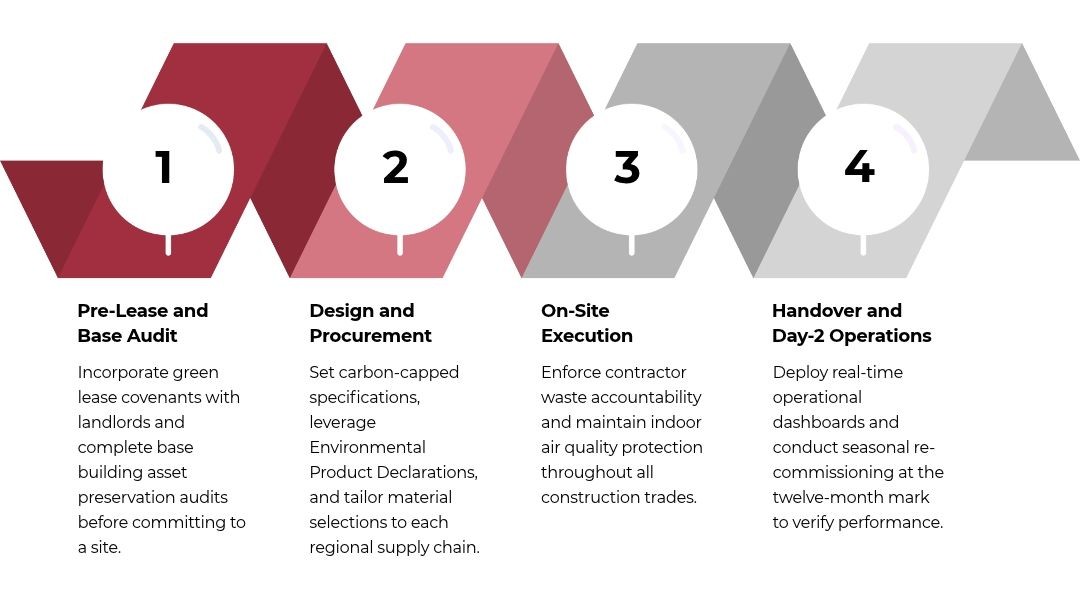
Organisations should pivot from inflexible global templates toward a "Global" Fit-Out Strategy (Global Intent, Local Execution), embedding regional parameters into every stage of the fit-out lifecycle across India, Singapore, and the UAE.
Driving Corporate Value Through Local Intelligence
The most effective regional standard for global enterprises is neither universally identical nor completely decentralised. Key decision-makers should retain strict control over common outcomes, data definitions, and evidence requirements while empowering local teams to adapt technical schedules to their specific city, asset, and market. Standardise your governance framework rather than every architectural product or engineering detail.
To succeed across APAC and the Middle East, leaders must embed regional sustainability decisions into leases, procurement briefs, capital budgets, and measurement plans. Integrating strategy, design, procurement, construction, and post-occupancy measurement under clear accountability drives genuine real estate value. We invite global enterprise leaders to conduct a regional workplace sustainability assessment to align their portfolio standards with local market realities and measurable business outcomes.
Frequently Asked Questions
Should global enterprises use one universal sustainability standard?
Strategic outcomes and data evidence rules should be universal. However, technical specifications for cooling, water management, material sourcing, regulatory compliance, and employee wellbeing must be adapted to each specific city and asset to ensure operational efficiency.
Which green building standards apply to APAC and Middle East projects?
Applicable standards vary significantly. Teams must navigate local statutory codes first, then consider voluntary frameworks like LEED and WELL, alongside regional systems such as the Building and Construction Authority Green Mark in Singapore, Estidama in the UAE, or the Indian Green Building Council.
How should real estate leaders compare offices across different climates?
Leaders should compare assets by evaluating local climate impact, grid emissions factors, water scarcity, landlord infrastructure, and material availability. Use common global metrics like Energy Use Intensity, but interpret the performance data against the specific environmental context of each location.
Do sustainable fit-outs carry a cost premium in emerging markets?
While some advanced technologies increase initial capital expenditure, strategies focused on asset reuse, efficient mechanical systems, adaptable space planning, and longer replacement cycles significantly improve overall lifecycle value and reduce long-term operational risk.
How can enterprises ensure landlord cooperation for ESG targets?
Enterprises must integrate green lease clauses during the initial negotiation phase. Securing legal rights to utility data, central plant efficiency metrics, and joint commissioning processes is critical before signing the lease, as landlord dependencies can dictate a tenant's sustainability success.
We use cookies to enhance your experience on our website, provide personalized content, and analyze site traffic.
By clicking "Accept All", you consent to our use of cookies. You can also choose "Preferred Cookies"
to select specific types of cookies that align with your preferences.
Essential cookies are always enabled to ensure website functionality.
You can choose to have only Essential cookies if you prefer minimal tracking.
Your choice regarding cookies on this site
Please choose whether this site may use Functional and/or Personalization cookies, as described below.
By selecting Required cookies only, you are requesting us not to sell or share your personal information.