Pharma Offices That Heal: How the World's Health Leaders Are Designing for Wellbeing & Innovation
Across industries, the return-to-office conversation continues to divide organizations, with many employees questioning the value of coming back to a physical workplace. But in the pharmaceutical sector, the equation is far more complex. Scientific progress depends on continuous collaboration and the ability for cross-functional teams to solve problems together in real time.
Researchers, analysts, regulatory specialists, and leadership teams rarely operate in isolation, making the workplace a critical part of how innovation happens. In this environment, the office must actively support deeper thinking and faster collaboration.
The Shift – From Functional Labs + Offices to Integrated Work Environments
Traditionally, labs were designed exclusively for research activities, while office spaces handled support functions in relative isolation from scientific teams. But the nature of pharma work has evolved. Today’s innovation cycles are more collaborative, requiring continuous interaction between research, quality, commercial, HR, and leadership teams. Modern corporate pharma offices must actively enable connected ways of working.
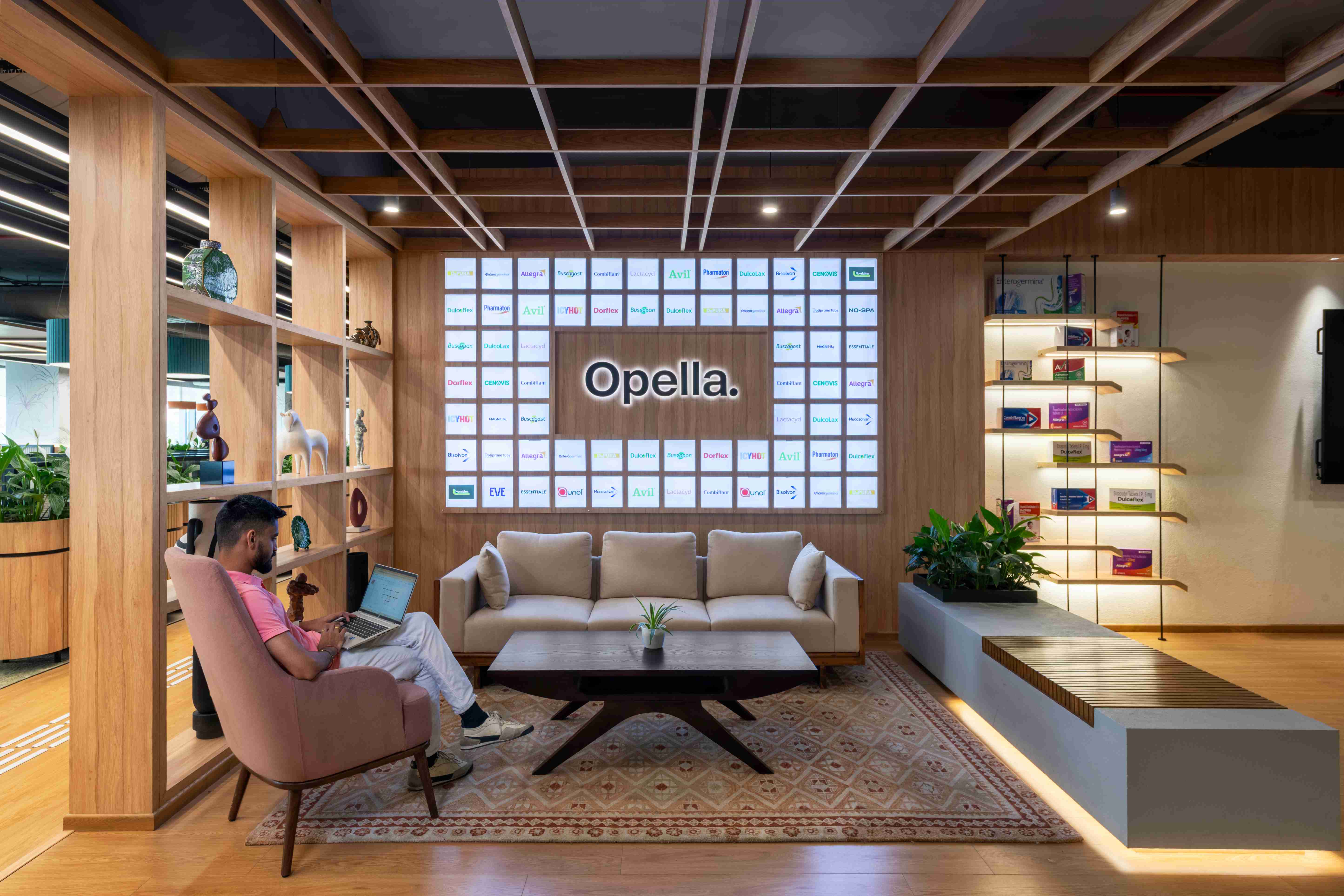
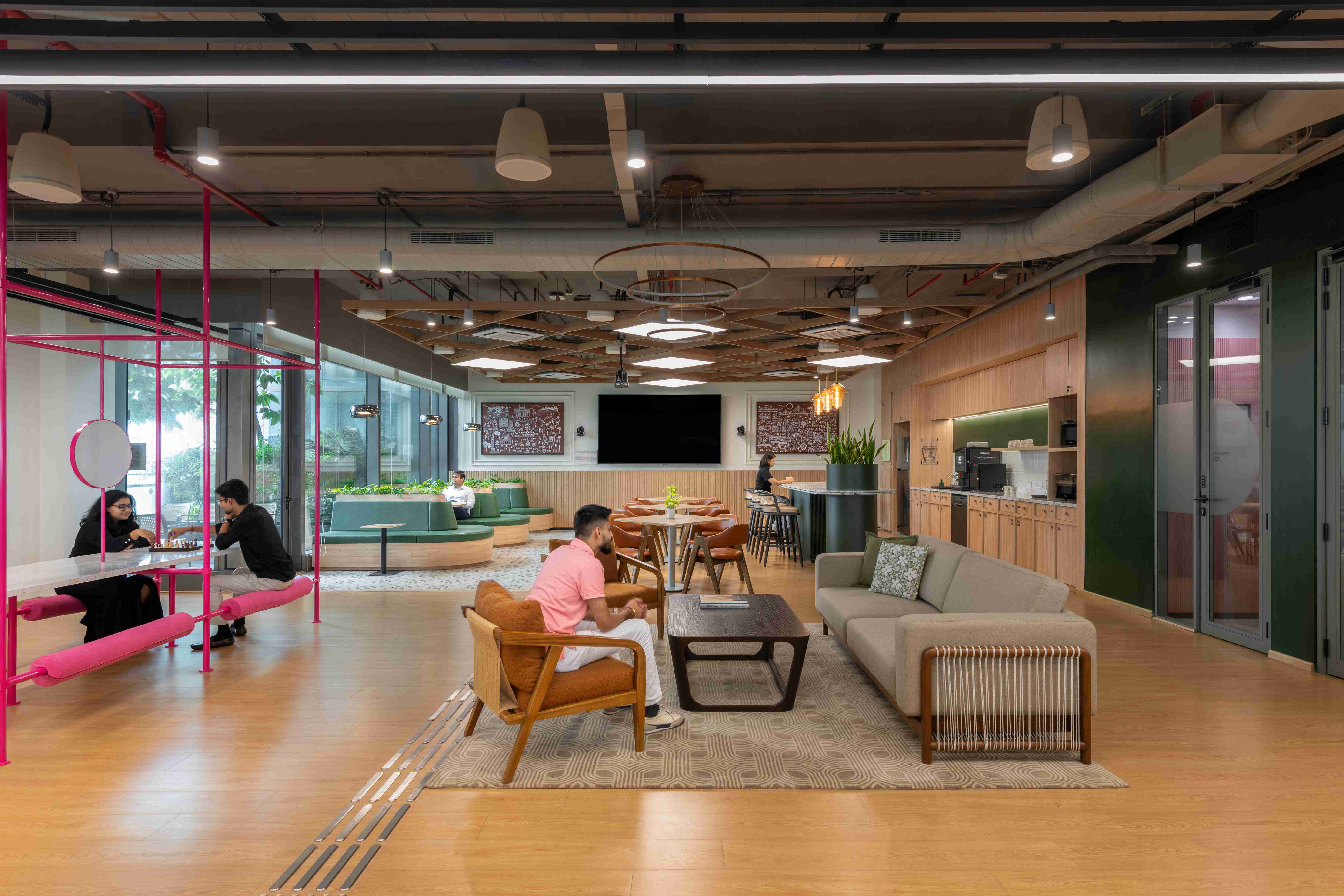
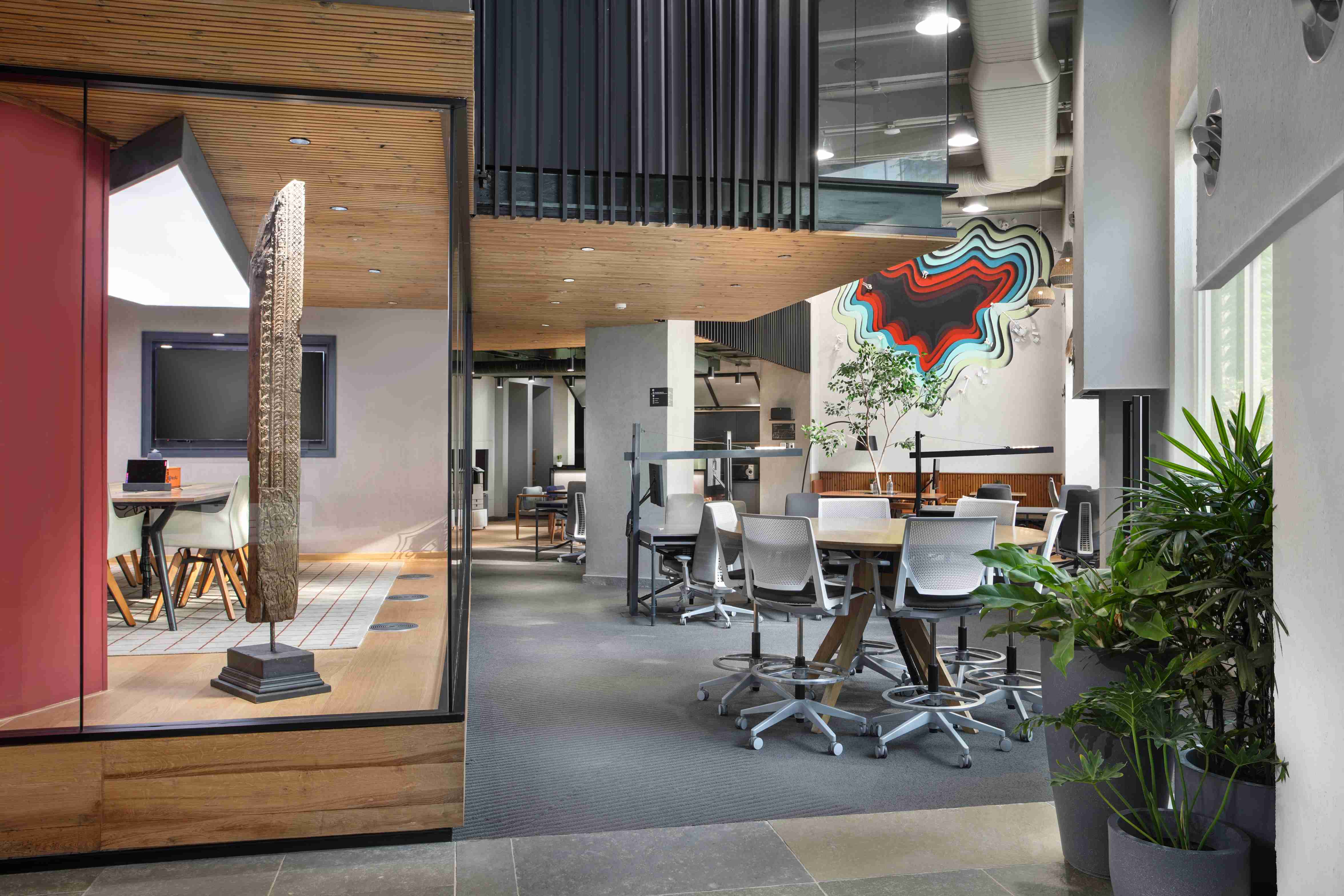
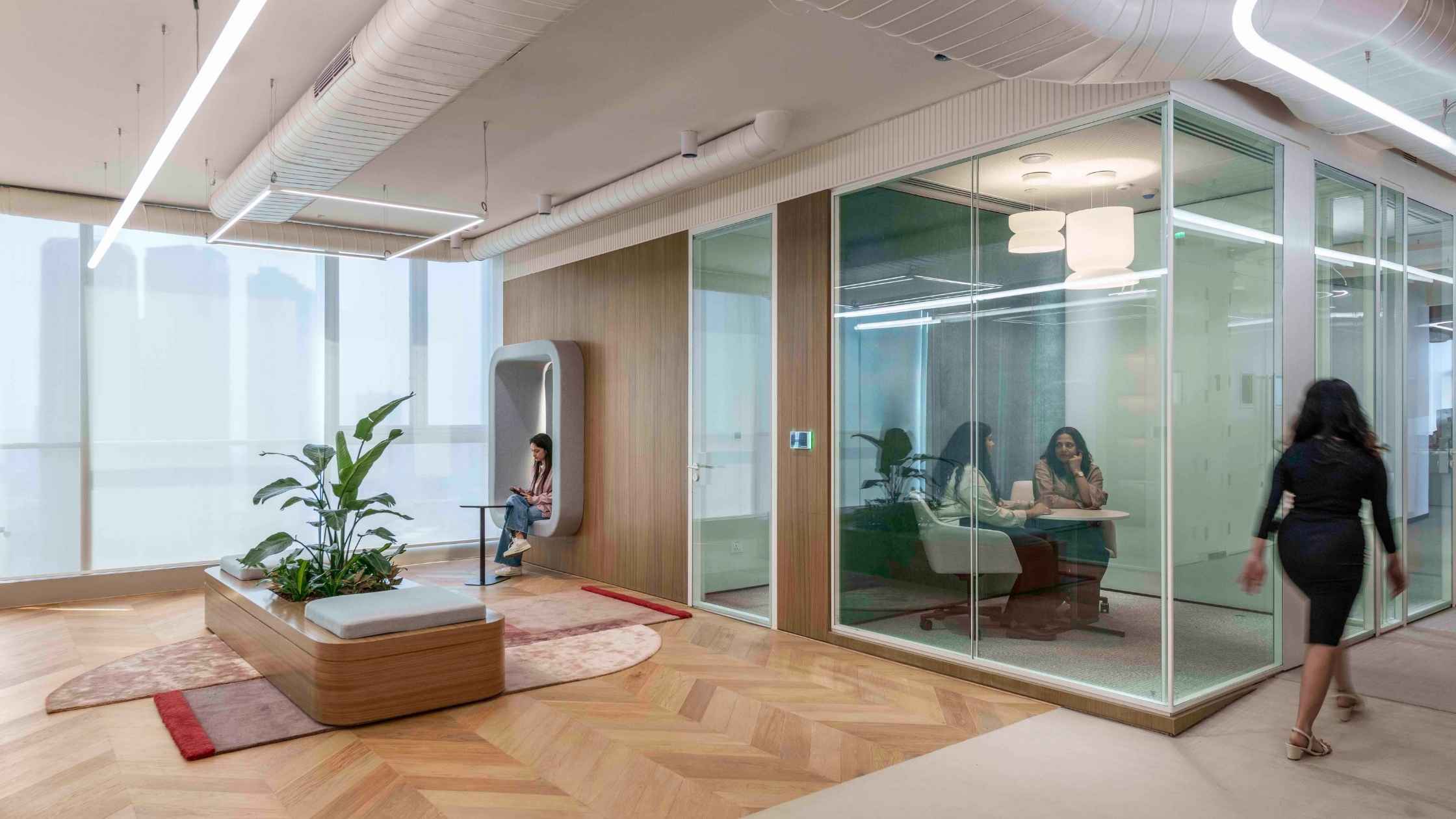
This shift is clearly reflected in the design of Opella’s Mumbai office. Rather than adopting a conventional pharmaceutical workplace model, the project reimagined the office as a strategic tool for cultural and operational transformation. Guided by the “Tree of Life” concept, the design focuses on creating stronger interconnectedness between teams while reinforcing Opella’s new identity rooted in growth, resilience, and accessibility. The placement of a central Workcafe at the core of the floorplate encourages daily interaction between GBS, Finance, HR, Sales, and Quality teams. Circulation pathways guide employees through collaborative hubs, transforming routine movement into opportunities for spontaneous dialogue and idea-sharing.
The project demonstrates how office design innovation in the pharmaceutical sector is increasingly centered around enabling seamless transitions between focused work and collaboration. Open workspaces along the perimeter maximize access to natural daylight, while biophilic elements and flexible seating options reinforce a human-centered experience. Importantly, the workplace balances collaboration with privacy by integrating phone rooms and focused spaces alongside activated social zones. The result is an environment that actively shapes how employees connect and contribute to Opella’s future.
The Wellbeing Imperative – Why It Directly Impacts Scientific Output
Pharmaceutical and healthcare-related work environments place exceptionally high cognitive demands on employees. Corporate pharma offices operate within long research and development cycles that require sustained concentration and analytical precision. In such conditions, workplace quality directly influences how effectively employees can perform over extended periods. Poorly designed environments can gradually contribute to mental fatigue, which has a direct impact on scientific and operational outcomes.
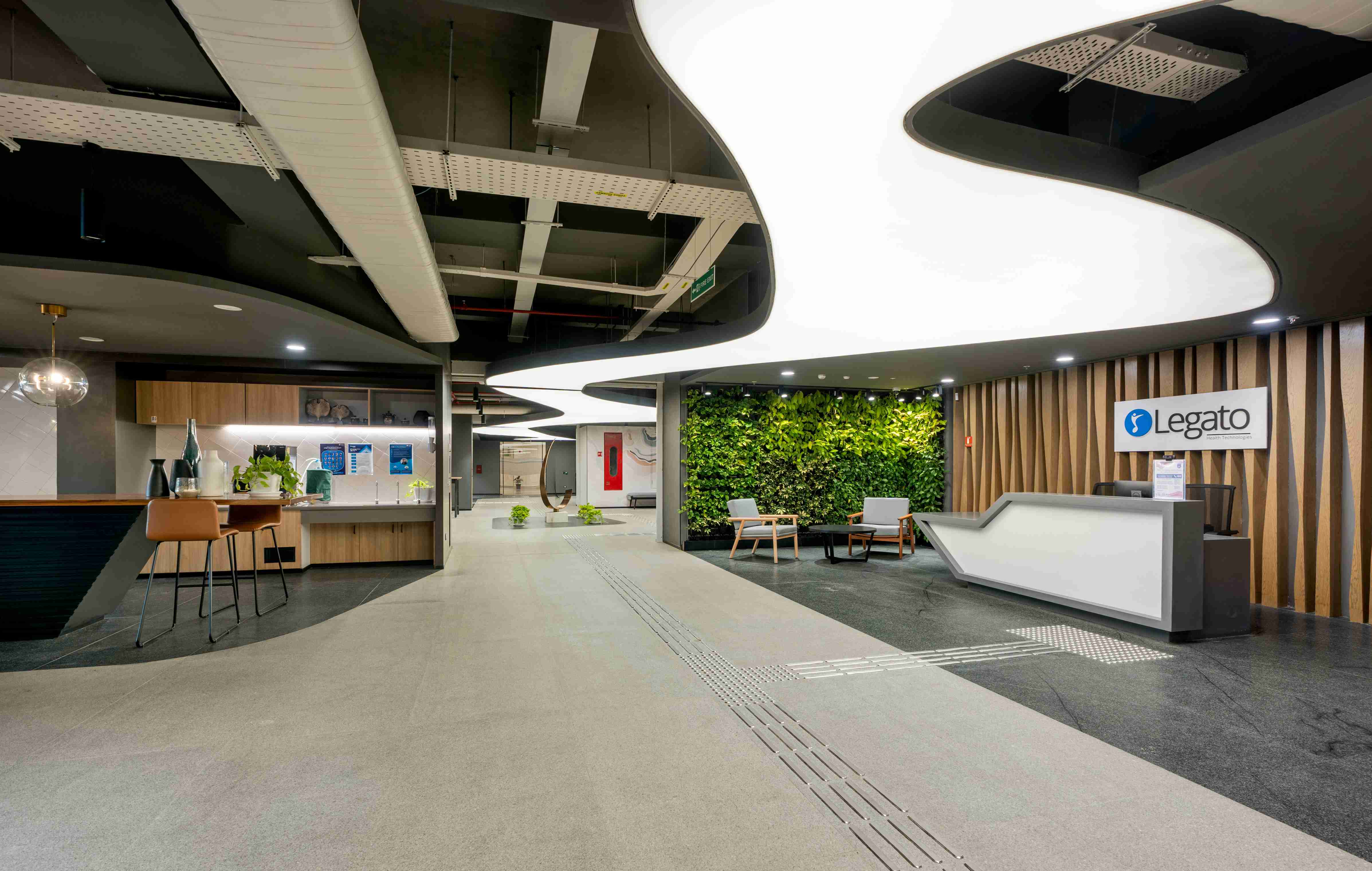
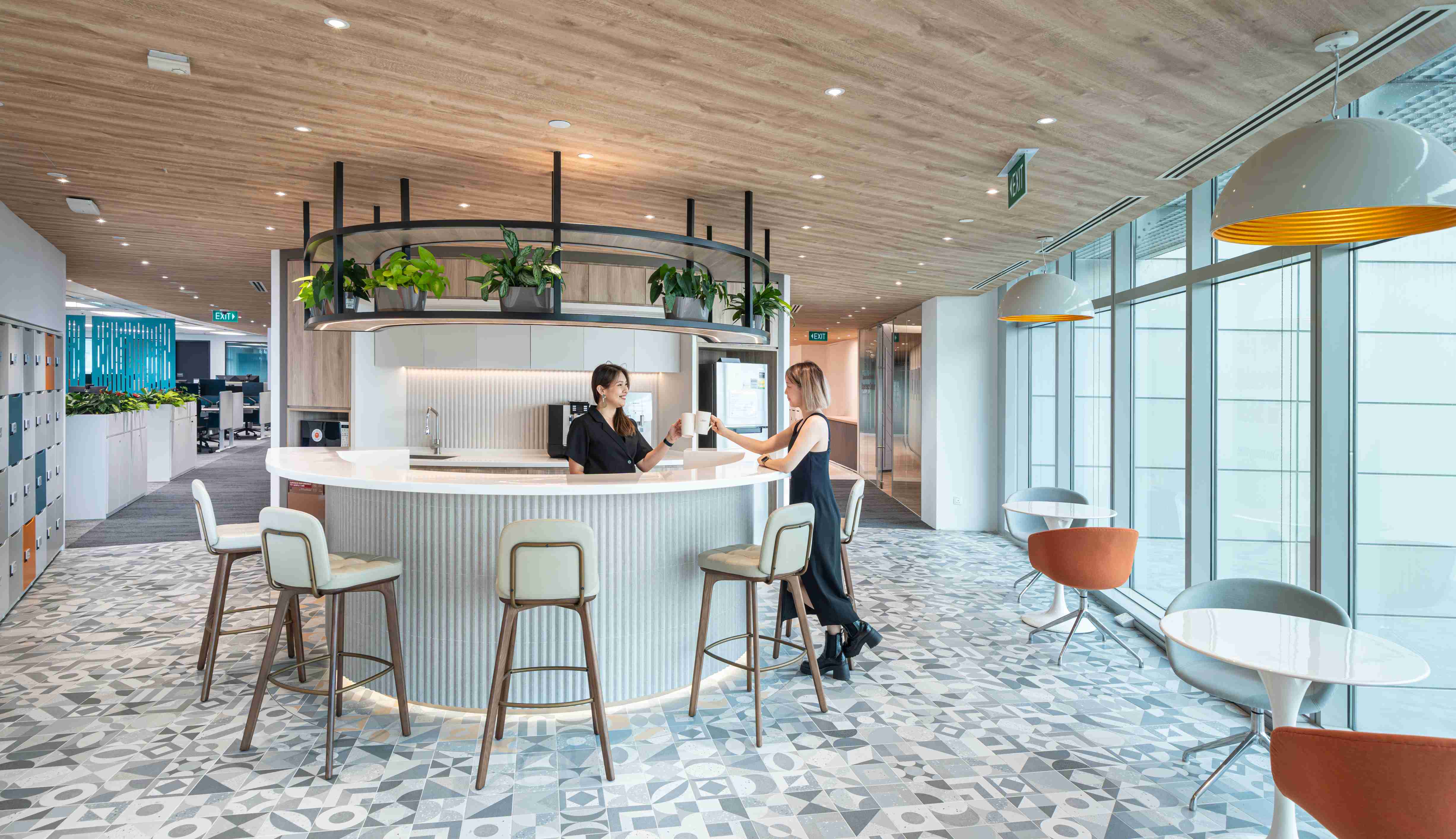
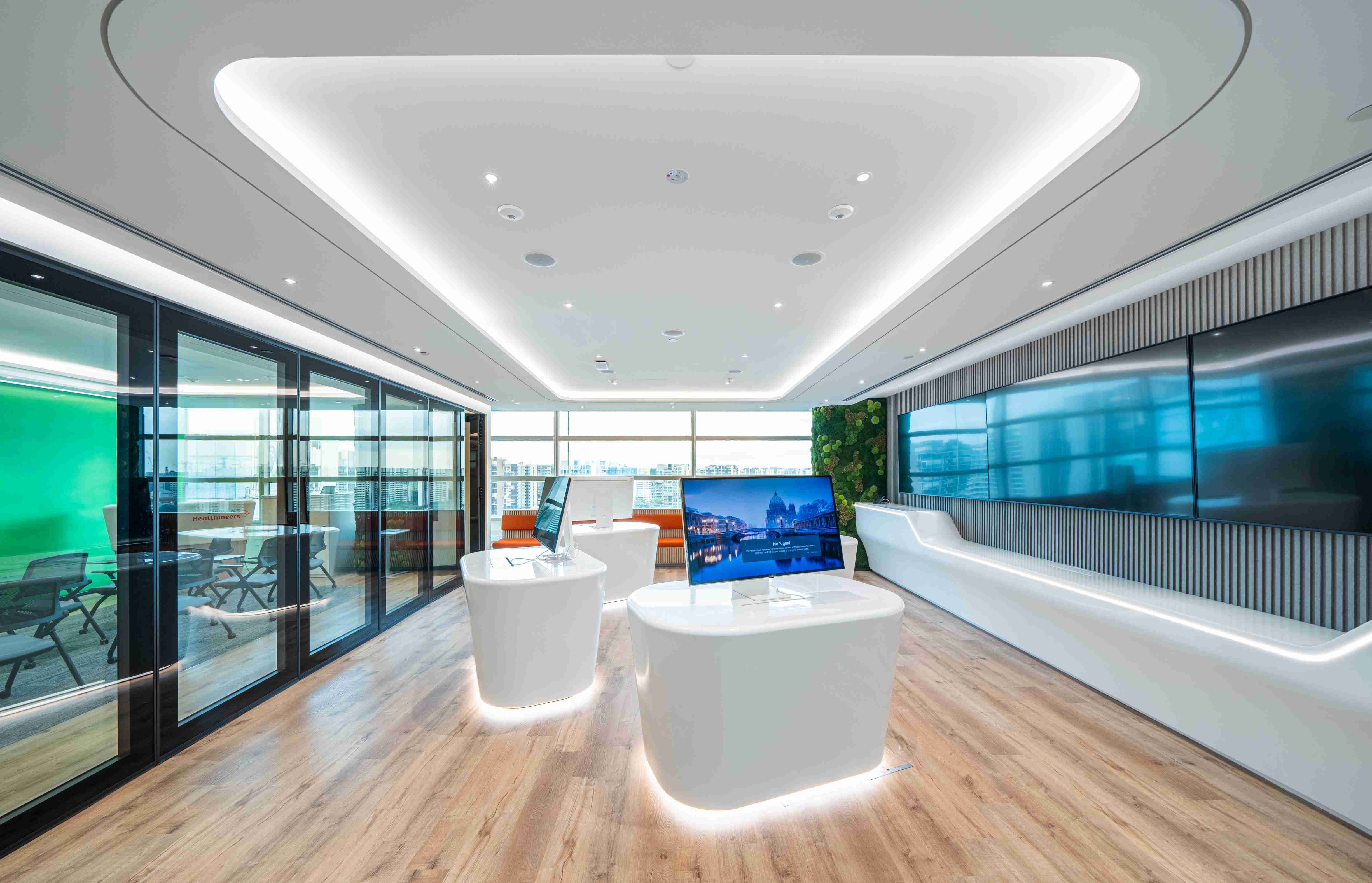
This challenge became central to the workplace transformation undertaken for Carelon. The organization sought to align its office environment with evolving ways of working while addressing barriers to collaboration embedded within its existing workplace design. Rather than relying on conventional layouts, the approach focuses on creating a more employee-centric environment that supports flexibility and adaptability. The resulting workplace introduces a hospitality-inspired arrival experience, spacious work cafes, flexible collaboration zones, and varied meeting spaces that allow employees greater choice in how they work throughout the day.
The project reflects how office design ideas are increasingly focused on creating environments that actively contribute to employee wellbeing. Integrating flexibility, collaboration, workplace technology, and comfort into a cohesive experience creates a workspace that supports clarity, engagement, and innovation. Importantly, the design also enables adaptability to support future growth and evolving work patterns. In healthcare and pharmaceutical sectors where precision and sustained performances are essential, wellbeing is a core operational requirement that directly shapes how effectively people collaborate and perform.
Designing for Innovation – Beyond Individual Focus to Collective Intelligence
Breakthrough innovation in the pharmaceutical industry rarely comes from isolated expertise. Modern drug discovery and scientific advancement increasingly depend on researchers, analysts, regulatory specialists, and commercial teams working together in highly interconnected ways. Rapid iteration, cross-functional problem-solving, and continuous knowledge exchange have become essential to accelerating innovation cycles. As a result, workplace strategies are evolving beyond supporting individual productivity toward enabling collective intelligence across teams.
This shift is changing how organizations think about corporate office interior designs. Instead of separating departments into isolated functional zones, companies are creating environments that encourage spontaneous interaction and easier collaboration between teams. Spaces that allow seamless transitions between focused work and group discussions help employees share ideas more naturally and solve problems faster.
An increasingly common question organizations are asking is: How should corporate pharma offices be designed to support innovation better? The answer lies in creating workplaces that balance concentration with connectivity. Employees still require spaces for deep scientific focus, but they also need environments that encourage informal conversations and quick collaboration.
The Corporate Pharma Offices Challenge – Balancing Control with Flexibility
Pharma environments are built around precision, compliance, confidentiality, and highly controlled processes that leave little room for inconsistency. At the same time, the expectations of modern work have shifted significantly, with employees seeking greater choice in how they work. This creates a challenging dynamic in which organizations must uphold rigorous standards without creating environments that feel overly rigid or restrictive.
The tension is especially visible in today’s corporate pharma offices, where teams require highly specialized environments and agile collaborative spaces within the same workplace. Researchers may need quiet areas for concentrated analysis, while cross-functional teams benefit from open discussion zones that encourage faster decision-making and problem-solving. Balancing these competing needs is not straightforward, as pharmaceutical workplaces cannot adopt generic, flexible office models without considering the operational realities of scientific work and regulatory requirements.
A growing question many organizations are asking is: How does office design innovation help resolve this challenge? The answer lies in designing environments that integrate structure with adaptability. Effective workplace strategies create controlled environments where precision and compliance remain uncompromised.
The Risk – When Offices Don’t Keep Up with How Pharma Work Has Evolved
As pharmaceutical work becomes more collaborative, data-driven, and interdisciplinary, outdated workplace models are creating growing operational risks for organizations. Spaces that were designed for siloed functions struggle to support the speed and complexity of modern scientific workflows. When teams remain physically and operationally disconnected, collaboration becomes fragmented, and opportunities for spontaneous knowledge-sharing are reduced. In an industry where innovation timelines directly impact competitiveness, inefficient workplace environments can quietly weaken scientific progress.
The challenge is becoming even more significant amid return-to-office expectations and global talent competition. Employees are far less willing to return to environments that fail to improve how they work. Many professionals now expect workplaces to actively support focus, wellbeing, flexibility, and meaningful interaction rather than simply providing desk space. This is placing increased pressure on corporate pharma offices to evolve into environments that deliver a clear functional and experiential advantage over remote work.
As a result, organizations are increasingly investing in office design innovation to create workplaces that align with how pharma work actually happens today. Modern workplace strategies have become critical enablers of collaboration, innovation speed, and talent retention. In highly competitive scientific industries, the workplace itself has become part of the organizational value proposition. If the workplace doesn’t enhance how work happens, it becomes irrelevant, even in industries that depend on it.
The Space Matrix Perspective – Designing for Science, People, and Performance
At Space Matrix, workplace design for the pharmaceutical sector begins with understanding how scientific work functions across research, operational, and leadership teams. Pharmaceutical environments are highly specialized, requiring spaces that support regulatory discipline while also enabling collaboration and faster decision-making. Rather than approaching workplace strategy as a purely spatial exercise, we focus on designing environments that align with workflows, communication patterns, and the day-to-day realities of how innovation moves through an organization.
This approach recognizes that effective corporate pharma offices must support human performance and scientific performance simultaneously. Teams need environments that support deep concentration for analytical work while also encouraging cross-functional collaboration and informal knowledge exchange. Integrating wellbeing into the everyday work experience becomes equally important. The goal is to create collaborative office space designs where people can work with greater clarity and efficiency.
Through thoughtful office designs, Space Matrix focuses on creating environments that strengthen collaboration across functions and support long-term innovation capability. The emphasis is on building workplace ecosystems that help organizations adapt to evolving ways of working in the pharmaceutical industry.
If your organization is rethinking how its workplace supports research, collaboration, and wellbeing, Space Matrix can help design environments that enable both scientific excellence and human performance.
We use cookies to enhance your experience on our website, provide personalized content, and analyze site traffic.
By clicking "Accept All", you consent to our use of cookies. You can also choose "Preferred Cookies"
to select specific types of cookies that align with your preferences.
Essential cookies are always enabled to ensure website functionality.
You can choose to have only Essential cookies if you prefer minimal tracking.
Your choice regarding cookies on this site
Please choose whether this site may use Functional and/or Personalization cookies, as described below.
By selecting Required cookies only, you are requesting us not to sell or share your personal information.